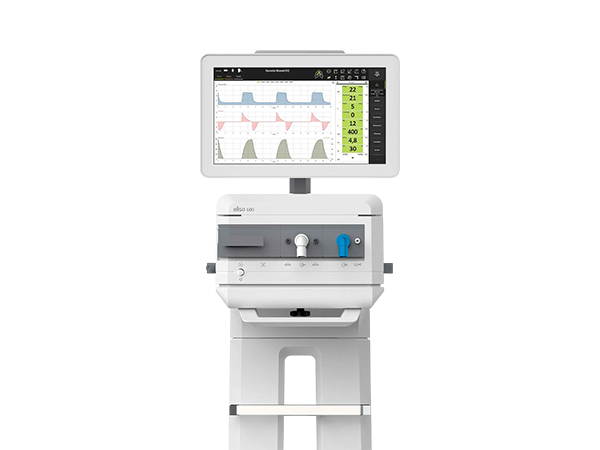
Transpulmonary pressure monitoring is an optional add-on.
Lung-protective ventilation reduces ventilation-associated complications, notably by decreasing the mechanical pressure and volume load on the lungs. Knowledge accumulated in recent years has proven that lung-protective ventilation is only possible by regularly adjusting ventilator settings to individual lung function. But what happens if the standard guidelines for lung-protective ventilation can no longer be followed?
Adapting ventilation therapy based on transpulmonary pressure measurement is a simple, minimally invasive, and valid method that requires only the placement of a modified gastric tube. Changes in esophageal pressure during a respiratory cycle reflect changes in pleural pressure. As the difference between ventilatory pressure and pleural pressure, transpulmonary pressure indicates the extent of mechanical stress exerted on the alveoli, which is consequently responsible for ventilation-associated lung injury. The inspiratory plateau pressure set on the turbine plays a secondary role. Studies have shown that, due to the significant variability in the lung-thorax elasticity ratio, a set inspiratory plateau pressure on the ventilator results in very different transpulmonary pressure gradients. In patients with elevated pleural pressure, for example, due to high intra-abdominal pressure, the same inspiratory pressure can be achieved with less ventilator-associated lung injury than in patients with low pleural pressure. Expiratory transpulmonary pressure (eTPP exsp) can then be adjusted by titrating the applied PEEP, since airway pressure is related to the applied PEEP. Unlike other methods for detecting individual PEEP, this method can also be used during spontaneous breathing and weaning. During weaning, esophageal pressure measurement can provide valuable information (unmasking patient-ventilator asynchrony, monitoring respiratory muscle effort, calculating intrinsic PEEP during spontaneous respiration, etc.) and allows for optimization of the weaning process. In this context, it is possible to determine the patient's work of breathing during assisted spontaneous respiration in acute situations, so that the necessary support can be directly adapted to the patient's individual lung function through pressure-based assistance.